
What Your Garage Door Is Trying to Tell You About Your Foundation
Most homeowners don’t think of their garage door as a diagnostic tool. It’s just something that opens and closes—until the day it doesn’t. Maybe it starts dragging slightly on one side, or it makes a sound you’ve never heard before. Sometimes it’s more subtle than that. The door still works, but it doesn’t feel quite right. The assumption is almost always the same: something inside the system is wearing out.
And sometimes that’s true. But in regions like Northeast Ohio—especially in areas like Hudson and Twinsburg—there’s another possibility that often gets overlooked. The issue may not be the door itself. It may be the surface beneath it, or the structure surrounding it, slowly shifting in ways that aren’t immediately visible.
When the Door Isn’t the Problem
Garage doors are far more sensitive than most people realize. They rely on alignment—clean, even, consistent alignment—to function properly. When that alignment changes, even slightly, the system doesn’t immediately fail. Instead, it adapts.
That’s when you begin to notice the small changes. The door may hesitate as it moves, close unevenly along the bottom, or produce a level of noise that wasn’t there before. These aren’t always signs of a worn-out part. In many cases, they’re signs that the door is compensating for something else.
That “something else” is often the concrete.
Concrete has a reputation for being permanent, but in reality, it’s constantly responding to its environment. In places like Northeast Ohio, that environment is anything but stable. Moisture levels fluctuate throughout the year, temperatures swing dramatically, and water works its way into small openings in the surface. When that water freezes, it expands. When it thaws, it contracts. Over time, that cycle begins to influence how slabs settle and how surfaces hold up.
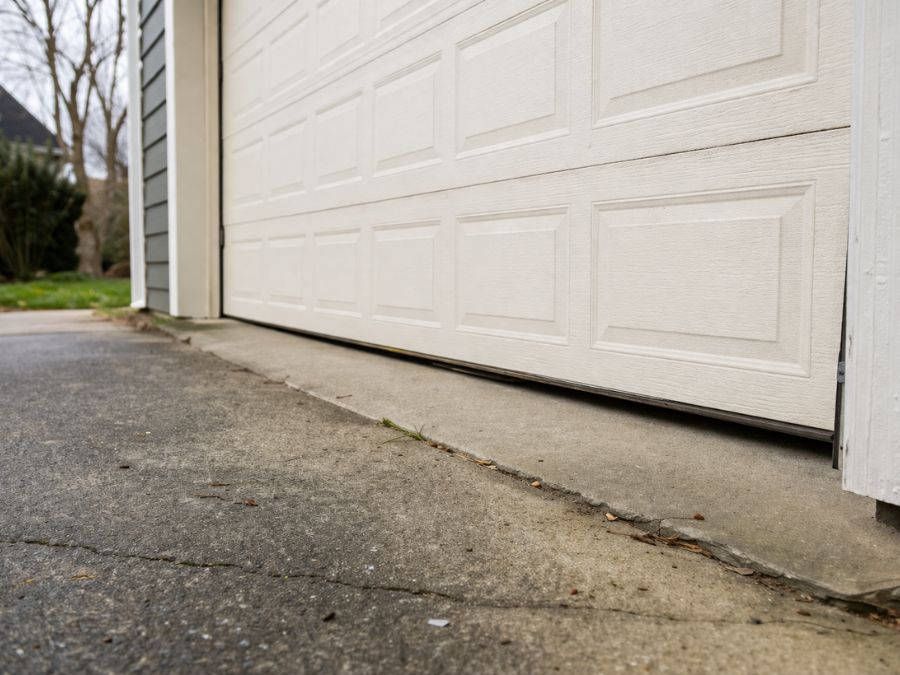
It rarely happens all at once. More often, it shows up as a hairline crack that didn’t used to be there or a section of the floor that feels just slightly uneven. Easy to ignore. But those small changes can have a larger impact than most homeowners expect. When a garage floor settles unevenly, even by a small margin, the opening itself can lose its symmetry. The door is still moving through the same space—but the space has changed.
How Small Shifts Turn Into Bigger Problems
Once that shift happens, the effects begin to build in ways that aren’t immediately obvious. The door may start placing more pressure on one side than the other, which leads to uneven wear across components that were designed to share the load evenly. Tracks that once sat perfectly in line can drift slightly out of position, and the opener may begin working harder than it used to.
None of this is dramatic at first. In fact, it’s often barely noticeable. But over time, those small imbalances add up. What begins as a minor inconsistency can turn into ongoing strain throughout the system, leading to repairs that feel necessary—but never quite complete. This is where many homeowners get led in the wrong direction. From the outside, these issues look mechanical, so they’re treated that way. Parts get replaced, adjustments get made, and for a while, things seem better. But then the same problems return.
It’s a perspective shared by Maxim Geht, owner of Ohio Garage Door Repair. He often finds that mechanical failures are merely symptoms of a deeper structural shift. “A lot of times, the door isn’t the component that’s failing,” Geht explains. “It’s reacting to a garage opening that has lost its square. If your concrete slab has settled or heaved, you’re essentially fighting physics. We tell our clients that a new motor is often just a temporary bandage if the foundation beneath it is the true culprit.”
It’s not that the repairs are wrong. It’s that they’re only solving part of the problem.
Why the Garage Floor Matters More Than You Think
The garage floor is often treated as a background surface—functional, but not especially important. In reality, it plays a direct role in how the garage door performs over time.
A stable, intact slab helps maintain a consistent opening, supports proper sealing at the base of the door, and allows the system to move evenly. When that surface begins to crack, settle, or deteriorate, those small inconsistencies start to show up in the door’s behavior.
While freeze-thaw cycles in northern climates create a specific set of challenges, homeowners everywhere—from the Midwest to the Southeast—deal with gradual slab movement, moisture intrusion, and long-term surface wear. In many homes, the first visible signs of a larger issue appear right there on the floor.
That’s part of the reason concrete specialists are often involved earlier than homeowners expect. Companies like Innovative Concrete Coatings regularly work with surfaces that have begun to show the effects of wear, environmental exposure, and structural stress.
Their approach focuses on restoring and protecting the concrete so it can better withstand moisture, temperature changes, and daily use. While many homeowners initially think of coatings as a visual upgrade, the long-term benefit is durability. A stronger, more resilient surface helps preserve the conditions that the garage door system depends on.
What to Watch for Before It Gets Worse
What makes these issues challenging is how subtle they are in the beginning. A small gap along the bottom of the door might not seem like a big deal. A crack in the floor might feel purely cosmetic. Even a slightly uneven close can be easy to dismiss.
But these early signs are often the clearest indication that something beneath the surface is changing.
Homes in Hudson, Twinsburg, and throughout Northeast Ohio are particularly susceptible because of the region’s environmental conditions. The freeze-thaw cycle alone puts constant stress on concrete year after year, and when you add shifting soil moisture and seasonal movement, gradual structural change becomes almost inevitable.
That doesn’t mean problems are unavoidable—but it does mean they’re easier to catch early than to correct later.
Looking at the Bigger Picture
When a garage door starts behaving differently, it’s natural to focus on the system itself. That’s the part you interact with every day. But in many cases, the more important question is what changed around it.
As Maxim Geht puts it, “A garage door should move clean and balanced. When it doesn’t, there’s usually a reason behind it. The challenge is figuring out whether you’re looking at a door issue or a structural one.”
That perspective can save homeowners from going through repeated repairs that never quite solve the problem.
A garage door doesn’t operate in isolation. It depends on the integrity of the space it moves through—on the foundation, the slab, and the surrounding concrete surfaces all working together. When those elements are stable, the system performs the way it should. When they begin to shift, even slightly, the effects show up in ways that are easy to misinterpret.
In a region like Northeast Ohio, where environmental conditions are constantly testing that structure, paying attention to what’s happening beneath the surface isn’t just good maintenance. It’s a way of staying ahead of problems before they turn into something larger.
Because sometimes, the first sign that something has changed isn’t a visible crack or a major failure—it’s simply the way your garage door starts to move.

